In an ideal world every Church with a graveyard would have a clear record of all the people buried in it. This is what we have tried to do here. St Swithun’s receive regular enquiries from around the world asking about the people buried in our 1.6 acre graveyard. I wanted to make our records …

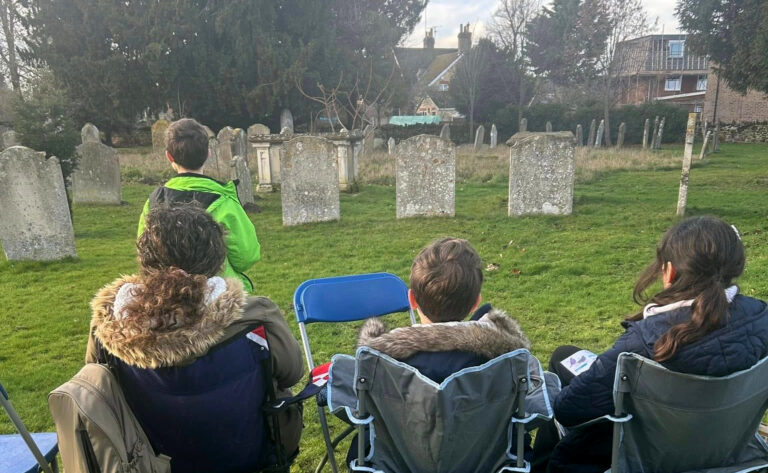
In an ideal world every Church with a graveyard would have a clear record of all the people buried in it. This is what we have tried to do here. St Swithun’s receive regular enquiries from around the world asking about the people buried in our 1.6 acre graveyard. I wanted to make our records available to everybody via this Web Site and I hope you find this document helpful. I’m happy to help, though – sometimes an exchange of emails is better than a spreadsheet so you’re welcome to drop me a line: snowleopard51913@gmail.com.
In November 1950, Sandy Council commissioned local Surveyor Reginald Settle to Survey the Churchyard. Mr Settle drew up 2 plans of the Yard numbering all 483 Graves and showing where each grave could be found. Typewritten lists, cross referenced to these grave numbers, listed the names of the 611 people the graves record, their age and the date when they died. Putting these lists on to a spreadsheet allows our graveyard to be searched by surname and Mr Settle’s plans allow the graves to be located easily. Where additional information is given on the stone I have added this in a Notes column. The second of Mr Settle’s plans (from Grave 198 to 482) also recorded the type of gravestone so I added this in a final column.
Some caveats:
- The graveyard closed in 1890. Burials after this were at Sandy Cemetery unless the Deceased was buried in a grave at St Swithun’s along with a family member who pre-deceased them before 1890.
- There are 39 gravestones that were indecipherable in 1950 and a further 6 graves which never had a stone. Nothing is known about these graves.
- The earliest burial on the Survey was in 1725 but there were burials for centuries before this. We have records in our Vestry of funerals from the 16th Century so, if you are searching for family members from the 1500s to early 1700s I’ll have a look for you, but it may take some 3 weeks to locate the records!
- Historically, St Mary’s Church in Potton was sometimes called Sandy Church. If you draw a blank with us or your family connections were in Potton you may wish to make enquiries of Potton History Society: https://pottonhistorysociety.org.uk.
Good luck with your research!
Stephen Snow
St Swithun’s Church
Sandy