References: Acts 17: 22 – 31 | John 14: 15 – 21

Here’s two statements. Both are true. What’s the difference between them? 128 + 47 = 175 is the first; The second is I woke up feeling strangely excited about the prospect of leading worship in Sandy today.
The difference I suggest is that one is easily provable by someone with a pencil and a piece of paper whereas for the other one you’ll just have to take my word for it! If I look particularly hang-dog by the end of the next hymn you might wonder if it was true but you’ll never be able to prove it one way or the other.
Here’s another statement. Which camp does it fit into? Is it provable or not? It’s some words of Jesus which we heard at the beginning of the gospel reading. ‘If you love me, you will keep my commandments.’ Is that provable? Or is it just some good advice from Jesus?
Because I think of myself as someone who loves Jesus. We’ll come back to what that might mean in a minute but although I think I love Jesus, I’m painfully aware of just how often I don’t keep his commandments. So does that mean I don’t really love him? How can I know what is true?
That’s the nub of where we’re going today? How do you love Jesus? What does it mean to love Jesus? And how can I tell if I do?
Let’s get one thing straight right at the start. When Jesus says, ‘If you love me, you will keep my commandments.’, he is not saying If you love me, you’ve got to be good enough. Because in the same chapter Jesus explains that his command is to love one another, rather than to keep the rules. It’s not about ticking the right boxes, rather it’s to do with recognising the right person.
Let’s face it, Jesus is dead right when he says to his disciples, ‘In a little while the world will no longer see me, but you will see me’. The first half of this sentence is easy. ‘In a little while the world will no longer see me’. The vast majority of the people you will meet in the street will not have a clue about how to see Jesus in the world. They will not recognise him in their neighbour. They will not think he is present or indeed interested in their lives. They will not begin to appreciate what relevance he could have for them in the complex world of 2026. If they acknowledge him at all it will be as a man with a beard and long hair living a long time ago, or possibly as a sort of spirit up in heaven patiently waiting for them.
‘In a little while the world will no longer see me, but you will see me.’ The second half of this sentence is perhaps harder to justify. ‘but you will see me.’ How do you see Jesus?
We can speak of lots of things? Seeing him in worship. In communion. In worship songs. Seeing him in the direction he gives for our lives. In the prayers we believe are answered. Seeing him in the eyes of vulnerable strangers. Seeing him in the love we share with people close to us. Seeing him in the glory of the created world. Seeing him in sacrificial giving by someone we don’t expect. And so much more. I hope you can identify with at least some of these if not all of them. But most of these statements are not objective truth in the sense of 128 + 47 = 175, they are subjective truth of the ‘I woke up feeling strangely excited about the prospect of leading worship in Sandy today’ variety.
However there is one truth that helps us which is vital and which, whether the ‘world’ likes it or not, is objectively true with huge amounts of evidence to support it. And there is another truth which is vital for those who do call themselves Christians when they are wrestling with seeing Jesus in the world and what it means to love him, but which is much harder for the world to spot. And both come out of our readings this morning. And it’s these two truths we’re going to look at next.
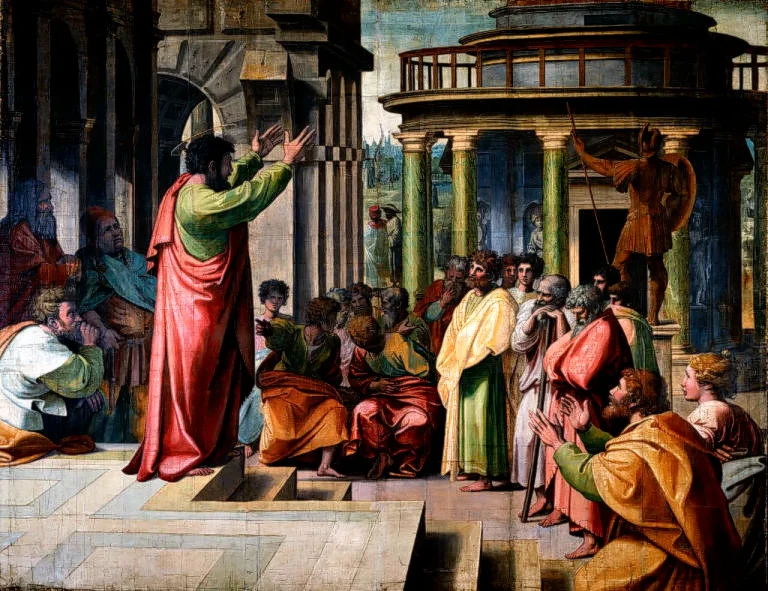
Let’s take the irrefutable one first. The irrefutable truth is that Jesus is risen from the dead. St Paul, when he was speaking to the Greeks in Athens, got them thinking about gods unknown to them in addition to Zeus and Athene and Mercury and so on. He spoke about Jesus being the God of all creation and came to the climax of his argument by saying it had to be true because Jesus has risen from the dead.
Many of the educated Athenians scoffed but the fact remains that there is a huge amount of evidence that Jesus really did rise physically from the dead. For me the two most powerful bits of evidence among many others are that if he hadn’t come back to life, why could no one produce his body to prove he was dead? And second, how come the disciples and early Christians were prepared to go through such danger and victimisation if they were concealing a lie that Jesus really was still dead? What would be the point? What would they gain?
No, the evidence is huge, that Jesus has risen. That he is alive. And for the last 2 000 years, no one has ever been able to prove otherwise.
And if Jesus really did rise from the dead; if Jesus really is alive, then everything else follows from it. God is real. Salvation is possible. Forgiveness of sins is a result of the love of Jesus on the cross. And our faith make all the difference in the world, and indeed to the world. That’s the Easter story. That’s why we’re here today and, like St Paul in Athens, we should be prepared to shout it out because it is just so amazing.
And in the Gospel reading, taking place just before the world changing events of the cross and the empty tomb, Jesus prepares his friends by saying all this in those same words. Words that he hopes will make sense to them after the resurrection if not before. ‘I will not leave you orphaned; I am coming to you. In a little while the world will no longer see me, but you will see me; because I live, you also will live.
Jesus is not leaving us orphaned. We will not be on our own because he is asking his Father to send his Spirit. ‘I will ask the Father, and he will give you another Advocate, to be with you for ever. This is the Spirit of truth, whom the world cannot receive, because it neither sees him nor knows him. This is the second truth which it is much harder for someone who would not call themselves a Christian to accept. Followers of Jesus have an advocate, a supporter, a friend, a comforter, an encourager and this is the Spirit of truth who gives us the ability to hold fast to the truths which bring life and prove Jesus’s love.
And if the Spirit is there as an encourager, then he helps us to love Jesus.
And if the Spirit is there as an advocate then he will act on our behalf in allowing the forgiveness of the cross to reassure us when we are so weighed down by the fact that we do not manage to keep Jesus’s commandments very well.
So to come back to the original question. What does it mean to love Jesus? Here are a few suggestions most of which emanate from the readings this morning.
To love Jesus is to keep his command to love our neighbour as ourself, Whether that is our next door neighbour with whom we have just fallen out, or the Somalian refugee in emergency accommodation down the road. It’s not about being nice to nice people. It is rather more to do with clearing up the vomit from the drunk teenage girl outside the nightclub and making sure she gets home safely. And there’s a little bit of resurrection in there.
To love Jesus is to strive to live a lifestyle that sits gently with the hurting creation which human beings are so busy exploiting. That’s not about enjoying a David Attenborough documentary, brilliant though they are. It’s rather more to do with not just assuming you can’t do anything about climate change so there’s no point trying. It’s definitely about making painful changes to your lifestyle in order to reduce your impact on the earth. And if you do, then it enables the new life of Jesus to breathe new life into a hurting world
To love Jesus is to see the possibility of new beginnings and resurrection in any difficult situation you are part of. It’s not about taking yourself away from relationships that are strained, protecting yourself from being hurt or upsetting other people by having nothing to do with them. Rather it’s about wrestling with them and allowing the Holy Spirit of truth to transform these relationships into something creative and hopeful. And that takes commitment. And that takes love. And certainly in my experience it requires the action of the risen Jesus through the power of his Holy Spirit to even begin to reach it.
To love Jesus is to be a warrior in prayer for the world. That’s not about mentioning a list which you want God to fulfil even if it is a list that benefits others rather than yourself. Being a warrior in prayer for the world means a dedication to holding the life situations of individuals before the Lord or the complex relationships of nations before the Lord. And praying for the Kingdom of God to come.
To love Jesus is to open your life to his Holy Spirit, the comforter, the encourager so that, even though it’s often only after the event, you can see his plan for your life and you realise how valuable you are in his sight. It’s not about success – which is just as well in my case. Rather it’s about trusting that the extraordinary things you seem to be challenged to do are in fact part of the working out of his Kingdom. And once again that’s an example of seeing the risen Jesus in the world.
And, yes, to love Jesus is to come close to him in worship with other lovers of Jesus, and through the power of the Holy Spirit, the Advocate, the encourager, to allow him to bring your life closer to him outside worship. It’s not about turning up to church because you feel you ought to, it is more about expecting him to change your life as a result of the worship you have given. And that’s the Holy Spirit again!
So based on these last definitions of what it means to love Jesus, how well do you think you manage? No, neither do I! But that’s the glory and wonder of being a Christian. We’re not asked to succeed. We’re merely asked to follow. To love. To trust. To accept forgiveness. And to dream. And all through the daily presence of the Holy Spirit. And that’s what it means to love Jesus. And when it happens that’s what it means to see Jesus.
So now go and do it! And see him!
Amen.