Isaiah 40: 12–17, 27–end; 2 Corinthians 13: 11–end; Matthew 28: 16-20


The newspaper arrives early each morning and I, who am normally up with the lark, put it on the breakfast table to await my father-in-law’s rather more sociable entrance some hours later.
I was so struck by the lead article in the lifestyle section a few days ago that it took me about 10 minutes longer than usual to make my morning cup of tea. It was a survey of self-help books on well-being. The reviewer had read 50 of them, and as I read through some of the titles my jaw, clearly innocent in the ways of the world, dropped lower and lower in surprise. I paraphrase as the paper has long since hit the recycling pile but here are some of the names of the books:
- How to get what you want from the people you want it from.
- You are the most important person in your life.
- Achieving peace of mind in 30 seconds a day
- How to put yourself first
It seemed clear that the assumption of all these 50 books was that the reader is the most important person and their needs and wellbeing should be prioritised over everything else. Rather different from the Christian gospel which baldly states using a well-known conversation of Jesus that in order to find life, it is God whom we should put first, then our neighbour, and last of all, ourselves.
It seems that being a Christian in this alien world of 2026, is to be rather aggressively different from the touchy feely self-help books that promise the earth for very little effort but oddly don’t seem to produce the goods.
My suggestion today is that if you want to feel good and purposeful the only way to achieve it is to explore the Christian God and see where it leads. My suggestion is that it will take more than 30 seconds a day, he’ll demand all day everyday, but it’s an adventure that will transform your life. But it does come with a health warning. It’s curiously addictive. The more you get to know him, the more of a commitment he’ll be.
Today actually we’ve got three self-help manuals, all taken from the great self-help manual known as the bible, and they all have an extraordinary amount to say about this God we are here to worship today. We can only scratch the surface but I hope that the scratching might stop some of your itching.
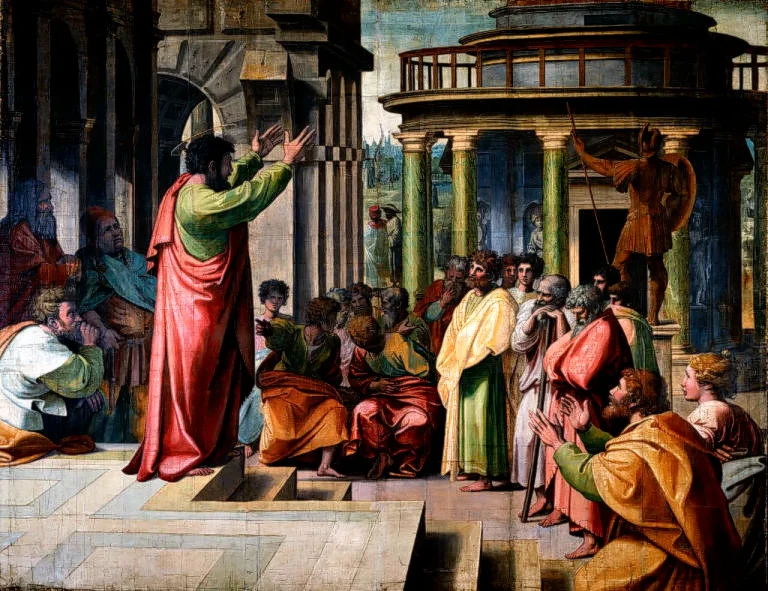
Paul wrote a couple of self-help manuals to the self-obsessed and troubled young Church at Corinth. He’d founded it a few years earlier on his first visit there. They were enthusiastic, self-opinionated and cosmopolitan, living in a vibrant and wealthy city and they soon thought they knew better than Paul. They argued amongst themselves and factions developed. They pushed at the boundaries of Christian morality, clearly enjoyed the good life and the Eucharistic meal of communion metamorphosed into an extravagant picnic where the rich fed sumptuously and the Christian slaves looked on enviously. Paul writes telling them to get a grip in 1 Corinthians and they don’t like it at all. 2 Corinthians is a letter full of reproach. We heard the final verses today. He calls them to ‘Put things in order, listen to my appeal, agree with one another’, which in their case would involve some rather hard work and a definite need for lots of the Church individuals to put themselves last rather than first. Not nearly as congenial as a self-help book from the pages of the paper! Paul calls them to ‘live in peace’ which is not silent stillness and escape but a vocal harmony and engagement.
These are easy words to say, but hard to hear, and almost impossible to achieve unless you take the focus completely off yourself and your strongly felt views and feast instead on the calling of the Christian God – more about him in a minute.
For you and I living a couple of thousand years later, Paul’s words are only likely to come alive if we relate them to our own Church experience. For actually, which church is not without its factions? Which church does not have to wrestle with complex moral choices in the world? Which church does not yearn for an easy life without the harsh challenges of survival in 2026?
If you apply these self-help suggestions of Paul to your own congregation, how helpful or challenging are they, ‘Put things in order, listen to my appeal, agree with one another, live in peace’?
In this passage the Trinitarian Christian God, Father, Son and Holy Spirit is explicitly called upon. We could easily meditate on any of the persons of the Trinity here but I want to mention the Holy Spirit because Paul highlights for us that closeness with God, and therefore the way to ‘Put things in order, listen to my appeal, agree with one another,’ and ‘live in peace’, is through communion or sharing with the Holy Spirit. Again in my experience, communing or sharing with the Holy Spirit is rarely a comfortable or a soft option. It involves hard work, self doubt, humility and the positive decision to put myself last rather than first, but it is also exciting, energising and fulfilling and allows my well-being to shoot through the roof because I realise I am part of God’s grand plan to save the world.
I’d love to hear your own stories on how the Holy Spirit changes your life by communing with you but sadly we’ve still got to mention the Father and the Son in order to get the full Trinitarian impact. It feels woefully inadequate but I’m already more than halfway through my allotted word count! … Maybe over coffee?
Isaiah wrote another self-help manual in our first reading. He asks, ‘Who has measured the waters in the hollow of his hand and marked off the heavens with a span’?, and continues with a whole host of other questions designed to help us think about God as creator and sustainer of life. Our lives are only in tune with the harmony of creation when we rely upon him instead of demanding our own comfort and using the precious resources of the earth to get what we want, ‘Lebanon would not provide fuel enough, nor are its animals enough for a burnt-offering.’
This is a passage which celebrates the active conversation between God and his wounded world. Our Father God is not a quiet God waiting for us to be still. The peace he seeks is living in harmony with creation rather than active aggression against all that does not provide for our comfort. Tell that to the climate change deniers. Our God is a God who loves and cherishes his creation and calls us to do the same. ‘Have you not known? Have you not heard? The Lord is the everlasting God, the Creator of the ends of the earth. He does not faint or grow weary; his understanding is unsearchable.’ The extraordinary thing about our immensely powerful God, attributes which this self-help manual celebrates, is that he seeks out the vulnerable and wearied and ‘He gives power to the faint, and strengthens the powerless.’ Good News indeed if you’re feeling the task ahead of you is beyond your capabilities. Don’t worry. It is! But it is also well within the amazing capabilities of our wonderful loving creator God. I love the promise of the final verse which I was going to leave for the climax to this disjointed sermon but in fact I’m going to quote now, before we even explicitly mention Jesus. When you next start doubting that God really has got it all under control, look up the final verse of Isaiah 40, today’s Old Testament passage and quote them out loud to yourself, ‘those who wait for the Lord shall renew their strength, they shall mount up with wings like eagles, they shall run and not be weary, they shall walk and not faint.’
And doubt is mentioned in our Gospel reading. So if you do doubt that it all makes sense, listen in and feel yourself included in God’s grand plan of salvation. Matthew writes about the moments immediately before Jesus, the Son of God, the third member of the Trinity to be mentioned today, ascended into heaven. When the disciples ‘saw him, they worshipped him; but some doubted.’ Some doubted but all were included. I find that unbelievably reassuring!
This is a great Jesus centred passage. He is never far away. ‘And remember, I am with you always, to the end of the age.’ This is a God who travels, moving, changing reality to make earth the heaven it should be by focussing upon his love and his sacrifice. Strangely sacrifice is not a word that crops up much in the survey of self-help books. There’s a lot in them about being kind to yourself. There’s a lot about giving yourself treats because you deserve it but very little about restraint and going short because you’re selflessly giving to others. Again distinctly different from the attributes of the Christian God we see in Jesus Christ, who gave us his own life because his love for us is so powerfully strong. This same powerful Christian God who raised his Son to life on Easter day to prove, as if it were necessary that no barrier is beyond his reach, not even the barrier of death and sin.
As I said this is a great Jesus centred passage. In it he calls us on a great mission to shout to the world the real way to find hope and meaning and self-worth. ‘Go therefore and make disciples of all nations, baptizing them in the name of the Father and of the Son and of the Holy Spirit, and teaching them to obey everything that I have commanded you.’ Don’t forget the final part of this sentence because in my not so humble opinion that’s where think the Church of England is going wrong at the moment. We’re good at baptising. Even Trinitarianally ‘in the name of the Father and of the Son and of the Holy Spirit’. We offer it as a free gift and are delighted when someone is baptised and joins our cosy little family. We are less good at ‘teaching them to obey everything that I have commanded you’, normally for fear of upsetting people. Perhaps the unmentioned demand of the three readings this morning is to be strident in proclamation of the truth, that the only way to find a life worth living is to follow Christ, honour God’s creation and live through the communion of the Holy Spirit?
I cannot shoehorn the Christian Trinitarian God into a nice tidy box marked ‘Open to find easy answers’. Thankfully God isn’t like that. He’s far too bumpy and dangerous. But I can offer you one challenge and one blessing.
The challenge is to hold whatever is big for you this week, either as an individual or as a Church. Hold it in your mind. . How does your response to it align to the self-help principles of the Trinitarian Christian God we have been discussing this morning? How far is it alien to these principles. Perhaps if you want that self-help wellbeing they need to be closer than they are at the moment?
The blessing is the much loved concluding words to 2 Corinthians, the passage we struggled with first. I’m sure you know them by heart. Hear them again and claim them for whatever challenges you have this week. ‘The grace of the Lord Jesus Christ, the love of God, and the communion of the Holy Spirit be with … you.’ Our great Trinitarian God.
Amen.