Trinity 4 (Proper 8) Jeremiah 28: 5-9; Romans 6: 12-end; Matthew 10: 40 – 42


A good friend who is a devout Christian, and is also very concerned about the climate crisis, all music to my ears, had lent me a book. She said it had helped her get her head round what was going on about climate issues and what we should be doing now.
I took it eagerly. Some of you may know that I am also writing a book about the connection between Christian faith and the extreme situation we seem to be facing at the moment, of which I guess, last week was an only too unpleasant reminder, and I wanted to find out what my friend’s book was saying that was so helpful.
I finished it just before we went on holiday. It was full of optimism. The gist seemed to be that if thoughtful, community minded people did the right thing then others would follow and the world would be saved. It suggested that we could start small: cycle a bit more; grow our own vegetables; install some solar panels. That sort of thing. Others would see the difference it made to our quality of life and start doing it as well, and soon the movement would be unstoppable. Sadly, sceptic that I am, I was not convinced. I felt the writer had ignored the problem of original sin. Human beings have a tendency to opt for whatever will make themselves feel good at that particular moment rather than making any sacrifices for the future. Of course we can all be altruistic on occasion but this seems to be the exception rather than the rule. In the extreme heat of last week caused by flagrant misuse of energy, I turned the fan on, thereby doing what made me feel better rather than striving for any long term solution.
I said as much to my friend when I gave her the book back who looked rather crestfallen. She said, ‘But it makes me feel better.’ Before I could stop myself, I retorted, ‘Well that’s nice for you then.’
‘It makes me feel better.’ You may have missed it but that’s the statement that each one of our three bible readings this morning is examining and when laid upon the scales is finding wanting in the balance. I want to look at them briefly and come up with some challenges about how the Church should be responding today.
Let’s start with Matthew, our Gospel reading. It’s pretty cheery really. Jesus is sending out his disciples to preach Good News and telling them that if people accept their message and welcome them, then they’ll receive a reward. That’s quite optimistic. We can go about handing out cups of cold water to little ones, make the world a better place and everyone will be happy. And if the cups are reusable rather than made of single use plastic it will be even better. That’s the problem with taking short passages out of context. You only have to read a few of the surrounding chapters of Matthew to realise that, more often than not, the real problem is that the message of Christ is not accepted, and that certainly seems to chime with the way society is heading today. We are not interested in a message that provides challenge and assumes commitment and hard work. We want a message that provides easy answers and results from our prayers. In my humble opinion, offering someone a reusable cup filled with cold water would not be as attractive as offering a 2 litre bottle of coke in single use plastic. That’s what most people are more used to and we would recycle the bottle if only we had the time.
I try to have a discipline that every time I go to our local Co-op I buy something for the Foodbank. The challenge I am faced with is that unless I buy pasta (wrapped in plastic) or baked beans, I am usually donating something that contributes to the modern problem of ready meals and poor nutrition. Children are less interested in cornflakes than they are in honey coated Cocopops and to what extent should my scruples get in the way and how much should I challenge dietary habits by what I buy? Does it matter? Am I a killjoy? Would more people come to church if we offered 2 litre bottles of coke at the door? I guess you know what I think! It’s just so hard to put into practice!
Jeremiah was faced with the same challenges, in our first reading, written at a time before coke had even been dreamed of. Again this is a small excerpt from a much larger story. Jeremiah had just heard the temple prophet Hananiah give a stirring message of hope to the deeply distressed Jewish people who were in the midst of the siege of Jerusalem surrounded by the aggressive forces of Nebuchadnezzar. Hananiah is promising relief of the siege, victory for the Jews and a return of all the temple treasure that has already been seized by Nebuchadnezzar. The people needed cheering up and Hananiah was giving them a much needed boost to help them to feel better. If it makes me feel better it must be alright. What could be wrong with that? Nothing at all, except that Jeremiah was convinced it was entirely unrealistic. Here the sarcasm in his voice as he replies to Hananiah and says, ‘‘Amen! May the Lord do so; may the Lord fulfil the words that you have prophesied, and bring back to this place from Babylon the vessels of the house of the Lord’. You may know that Jeremiah was proved right and Hananiah’s words were empty indeed. But Jeremiah got physically assaulted as a result of his truthful prophetic bravery. And Jerusalem was reduced to a heap of rubble.
‘Whoever welcomes a prophet in the name of a prophet will receive a prophet’s reward’. It would be much easier if the Christian message, the prophetic word of Jesus was one that was more attractive to people, contained less challenges about how they should live their daily lives and simply made people feel better. But actually if I’m going to love my neighbour in the slum of earthquake ridden Venezuela, or the 40 degree heat of Hitchin, or the queue at the Foodbank it is going to harm my wallet, affect the way I vote and dictate how I respond. And all of that I find immediately challenging. And so did Jeremiah.
You could be excused for not knowing that it is these same challenges that Paul is addressing in our rather longer second reading from Romans. It is a chapter all about choices and living in reality rather than in a dream world of how we might like life to be. And Paul is starkly clear. Either we serve selfish sinful desires or we serve Jesus. And every decision we make is going to be one or the other. ‘No longer present your members to sin as instruments of wickedness, but present yourselves to God as those who have been brought from death to life’. Don’t make the same old selfish sinful choices just because they’re easy and convenient and more immediately attractive and provide instant solutions. The ready meal way of life. Don’t just shake your head when you hear about the earthquake on Venezuela. Go online to Christian Aid and give something. Don’t just jump in the car when you need to get some bread. Consider whether you can walk. Don’t just save money for the church by buying the cheapest paper you can find. Make sure it’s sustainable and recycled. And encourage people to get the news sheet electronically instead. Is it really sinful if you don’t do any of these? Does it really matter? I’ll leave that to your conscience to decide!
‘No longer present your members to sin as instruments of wickedness, but present yourselves to God as those who have been brought from death to life’. It’s easy to think that sin will only really catch up with us when we die and are facing the mercy seat of Jesus and that as long as we’ve repented by then, all will be well. Well sadly all is not well now. It’s not well for the impoverished citizens of Venezuela in their cheap non-earthquake resistant dwellings built under a very oppressive regime. It’s not well for the children of the petrol heads at the filling station as they pour fuel into their gas guzzling cars. And it’s certainly not well for the single parent at the Foodbank who doesn’t know how she’s going to pay her rent and is facing eviction.
Can we do what we want? ‘Should we sin because we are not under law but under grace?’ ‘By no means!’ How we live. What we choose to follow: sin, or our own desires, or God’s plan for the world; matters. It matters to the people whose lives we consciously or unconsciously affect by those individual daily decisions. And surprisingly it makes a huge difference to us as well because, as Paul tells the Romans ‘the advantage you get is sanctification. The end is eternal life.’ And in case you were unsure, that’s eternal life now rather than at some indeterminate point in the future.
I fervently believe that human beings can’t halt climate change. We’ve made too many selfish decisions to be able to do that and the cost to our way of life would be so immense that nobody, not even you or me would choose to do it. We are all fallen human beings living in a broken world, slaves to sin. The Good News of Jesus is that by his death and resurrection, by his involvement with the nitty gritty of daily life, touching lepers and confronting demons, he has given us a way out of this disaster and a an assurance that God does care. That he will save the earth. That the Kingdom of Heaven really does include the hurting world of which we are part, just renewed, restored, forgiven.
However the flip side of this is that he does not condone the selfish decisions we keep persisting in making. If we want to live in this new Kingdom, we will have to be prepared to change and the sooner we start doing that the nearer to living under grace than under law we will be. And the sooner we start wrestling with this change the better.
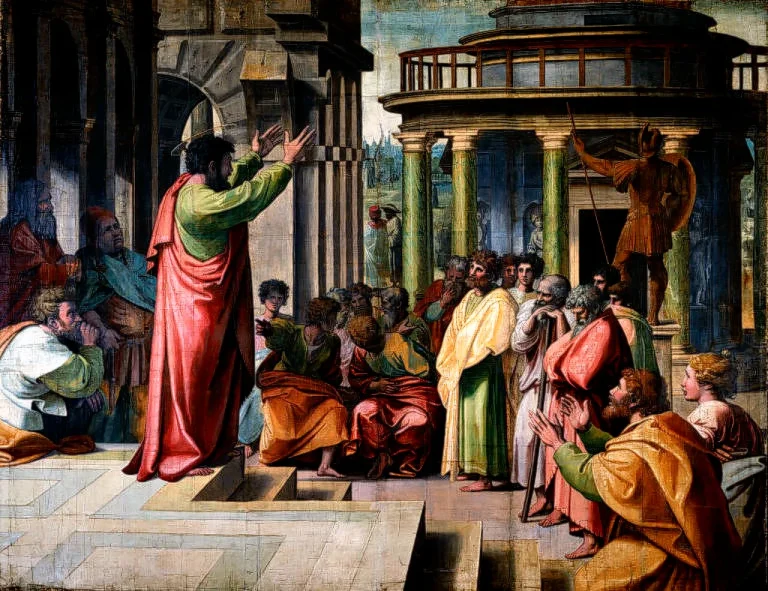
In my experience people do not want to hear this. They do not want to be told they are going to have to give up their own little kingdoms where they are ruler and follow the one true King. They didn’t want to hear it in Jeremiah’s time. They didn’t want to hear it in Jesus’s time – it cost him his life. They didn’t want to hear it from Paul either and he was arrested, sent for trial in Rome and almost certainly executed. And they don’t want to hear it today. If I’m brutally honest, I don’t want to hear it either.
So the Church has a choice. Do we preach a message of hope without challenge? God loves you and wants you to have a happy and stress free life. Or do we preach a message that connects with the failing and hurting world in which we live? And how do your daily decisions support or detract from the message of the Church?
The constant message of the false prophet Hananiah is peace and security. How seductive! I pray the Church does not fall into the same seductive trap.
Amen.